
Research
Creation of New Photofunctional Materials Based on Cooperative Effects
Research Philosophy and Objectives
At Ikeda Laboratory, we aim to create advanced materials with high functionality and performance, focusing on three key words: polymers, liquid crystals, and light.
Recent advances in computational science and artificial intelligence (AI) have made it possible to predict the properties and functions of individual organic molecules with remarkable accuracy. Furthermore, dramatic progress in synthetic chemistry has enabled to synthesize virtually any organic molecule. However, even when molecules are designed based on computational predictions, synthesized, and evaluated for their physical properties and functions, the desired properties and functions are rarely achieved.
This highlights a fundamental fact: the physical properties and functions of materials cannot be understood simply as a linear extension of those of individual molecules. Materials are assemblies of molecules, and the arrangement and orientation of molecules within a material are decisive factors governing its macroscopic properties and functions.
In other words, the molecular alignment and arrangement of functional molecules within devices are crucial for achieving high-performance devices. Precise control over molecular alignment can lead to dramatic improvements in device performance.
At Ikeda Laboratory, we focus on light as a functional stimulus and conduct research on photofunctional materials. Through hands-on research spanning the entire process—from compound synthesis to material fabrication and characterization—students can acquire a broad range of knowledge, technical skills, and scientific perspectives.

Macroscopic properties of polymer materials originate from microscopic structure and behavior of polymer chains. Controlling the orientation and alignment of polymer chains is important in improving mechanical, electronic and optical properties of polymer materials. We explore two approaches below to control the molecular orientation precisely.
• Use of self-assembling polymers
Introduction of liquid-crystalline molecules into polymers enables the orientation of polymers at the nanometer scale.
• Control of the orientation using external field
Utilization of light enables precise alignment of chromophores through non-contact and remote controls.
We are currently investigating the following two types of photofunctional materials.
1. Photomobile Materials
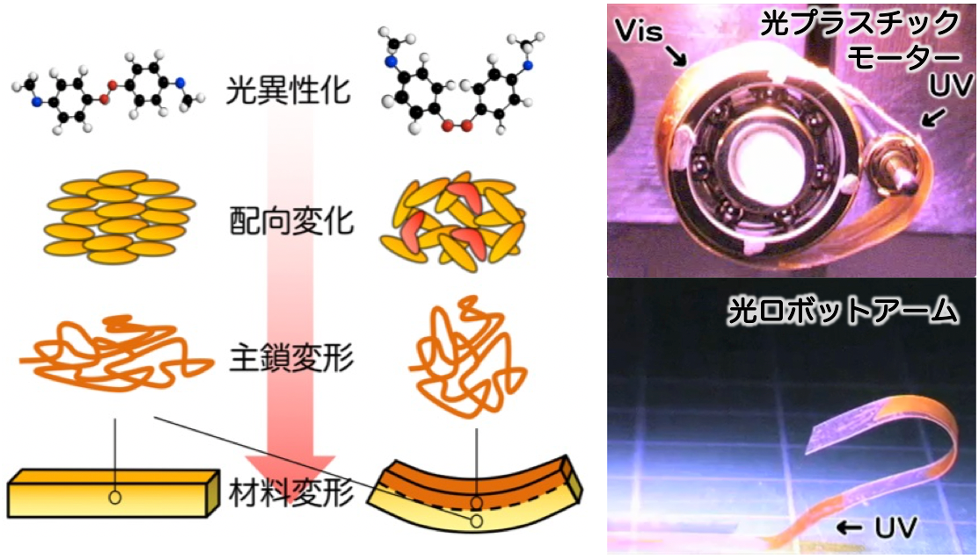
By incorporating photoresponsive molecules into liquid-crystalline polymers and crosslinking them, we can obtain crosslinked photochromic liquid-crystalline polymers.
In these polymers, the photochemical reactions of photochromic molecules, the alignment of liquid-crystal molecules, and the morphology of polymer chains are strongly coupled. When light irradiation induces photochemical reactions, molecular-scale changes are amplified and converted into macroscopic changes in material shape.
This enables the realization of polymeric materials that directly convert light energy into mechanical work. Using these materials, we can fabricate three-dimensional plastic motors and robotic arms that operate solely through light irradiation, without requiring batteries or generators.Our research brings us one step closer to the long-standing dream of directly converting light energy into mechanical motion.
2. Smart Windows
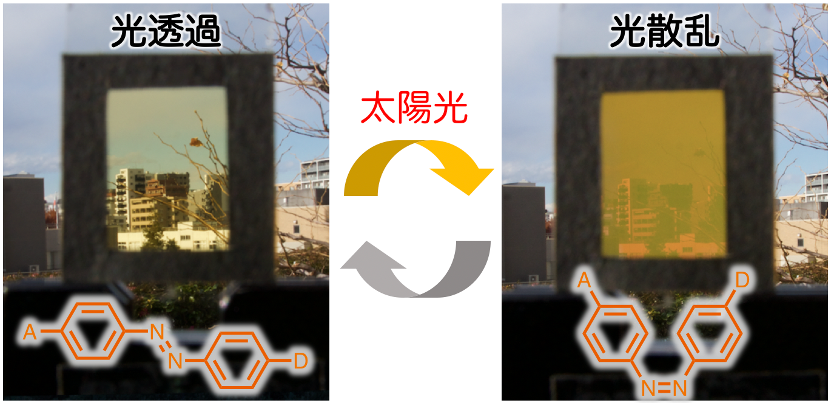
Smart windows that can control the transmission of sunlight are attracting considerable attention as next-generation energy-saving materials. At Ikeda Laboratory, we have developed a sunlight-driven smart window that autonomously blocks sunlight under intense solar irradiation by exploiting the photoinduced phase transition of liquid crystals. Since this smart window uses sunlight itself as its energy source, it requires no electrical wiring and can be easily installed. It is expected to significantly reduce energy consumption for air conditioning in buildings and vehicles. More recently, we have also developed a novel driving method that dramatically expands the operating temperature range.
[Examples of Photomobile Materials]
Light-Driven Plastic Motor
Light-Driven Robotic Arm
Inchworm Walk
We carry out research as a unit in Research and Development Initiative, collaborating with the Faculty of Science and Technology.
Journal Coverpages
 |
 |

|

|

|

|

|

|

|

|

|

|